
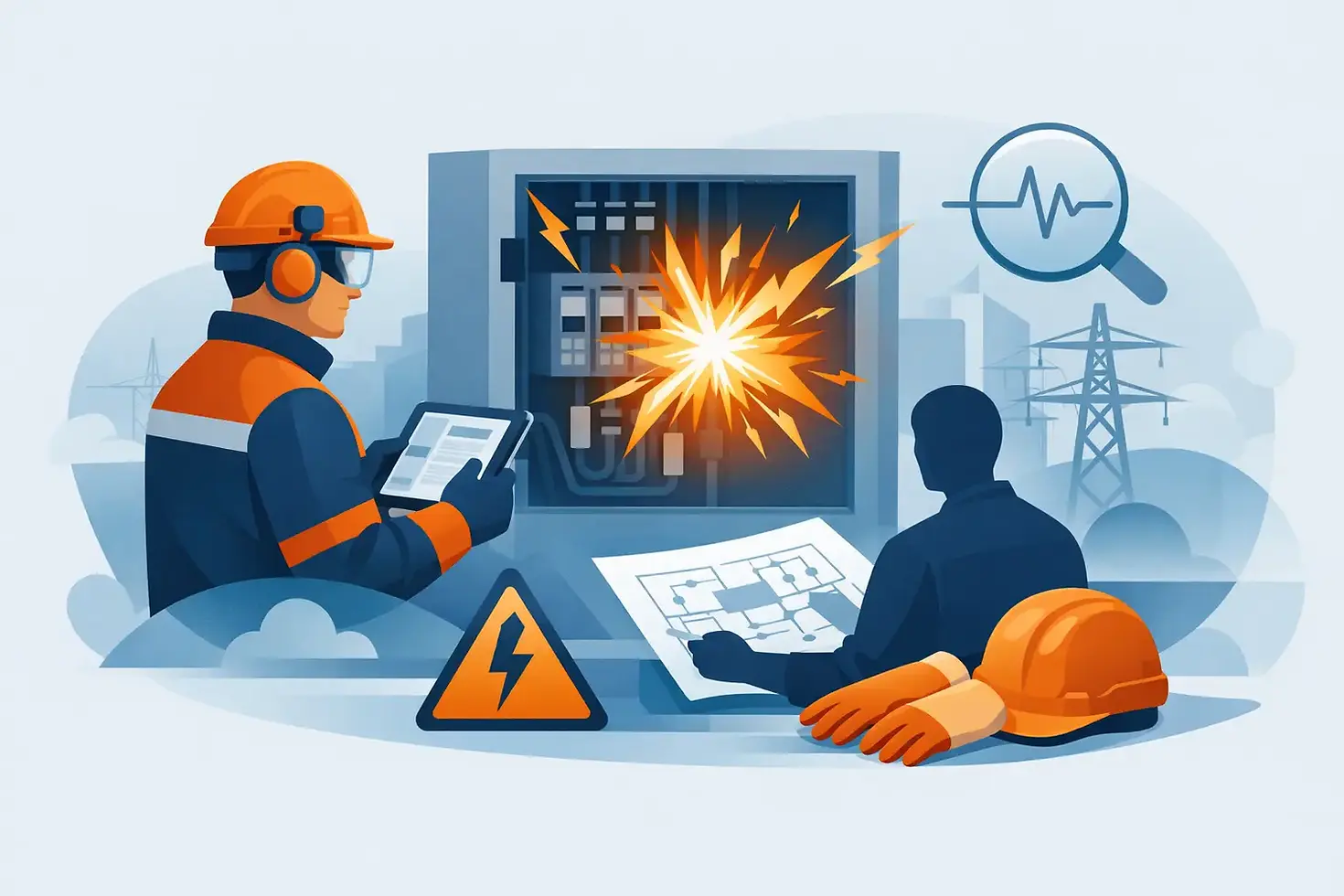
What Is an Arc Flash Study?

If your switchgear labels are missing, your one-line diagram is outdated, or your team is opening energized equipment without current incident energy data, the real question is not whether you need more safety documentation. It is what is an arc flash study, and whether yours is accurate enough to protect workers and support compliance.
An arc flash study is an engineering analysis used to determine the potential thermal energy released during an electrical arc event at specific equipment in your power distribution system. That analysis is used to calculate incident energy, arc flash boundaries, and in many cases the personal protective equipment level or category needed for tasks performed on or near energized equipment. It also supports equipment labeling and helps employers meet key requirements tied to NFPA 70E and OSHA's expectation that electrical hazards be assessed and controlled.
For facilities that operate energized systems, an arc flash study is not a paperwork exercise. It is a decision-making tool. It tells you where exposure is highest, where protective devices may not be clearing faults fast enough, and where engineering changes can materially reduce risk.
What is an arc flash study used for?
At a practical level, the study answers a few critical questions. If a worker interacts with a panel, motor control center, switchboard, or other energized equipment, how severe could an arc flash be at that location? How far away does the hazard extend? What information should appear on the field label? And are there system changes that could lower the hazard?
Those answers affect daily operations. Maintenance planning, energized work decisions, PPE selection, training, and labeling all depend on having defensible data. Without that data, facilities often default to assumptions. Sometimes those assumptions are too conservative and create unnecessary burden. In other cases, they underestimate the hazard and expose workers to unacceptable risk.
An arc flash study also creates a technical basis for remediation. If incident energy is extremely high at a piece of equipment, the next step may not be more PPE. It may be changing settings, improving coordination, adding maintenance switches, installing arc flash detection, or upgrading equipment so fault clearing happens faster.
What is included in an arc flash study?
A proper study starts with system data. Engineers gather equipment nameplate information, transformer details, conductor lengths and sizes, breaker and fuse data, and utility source information. They also review or build current one-line diagrams. If the one-line is incomplete or outdated, that issue has to be addressed first, because the model is only as good as the field data behind it.
Once the data is collected, the electrical system is modeled in software such as SKM or ETAP. The engineer then performs several related analyses. A short-circuit study establishes available fault current. A protective device coordination review examines how breakers and fuses respond to faults. The arc flash analysis then uses that information to calculate incident energy at working distance and determine the arc flash boundary for each relevant bus or equipment location.
The final deliverables typically include an updated one-line diagram, engineering calculations, equipment-specific arc flash results, and field labels. In many cases, the report will also identify recommended corrective actions if hazards are elevated or if protective devices are misapplied.
Why short-circuit and coordination matter
Some facilities think of arc flash as a stand-alone study. In practice, it depends heavily on the upstream analyses.
Short-circuit values matter because available fault current affects how an arc develops and how protective devices respond. Coordination matters because clearing time is one of the biggest drivers of incident energy. If a breaker takes too long to trip for a fault in downstream equipment, the energy exposure rises quickly.
This is why two similar pieces of equipment can have very different arc flash results. Voltage alone does not tell the story. Device settings, equipment condition, transformer size, conductor impedance, and system configuration all affect the outcome. That is also why remediation cannot be based on labels alone. If the study identifies high incident energy, someone needs to look at why.
Why an arc flash study matters for compliance
NFPA 70E requires an arc flash risk assessment to identify hazards, estimate the likelihood and severity of injury, and determine protective measures. OSHA does not prescribe a single study format, but it does expect employers to assess workplace hazards and protect employees from recognized dangers. In an energized electrical environment, that expectation is hard to meet without current system analysis.
A current arc flash study supports several core compliance needs. It provides the technical basis for equipment labeling. It helps define PPE requirements. It informs energized work planning. It supports training by giving workers realistic hazard information tied to actual equipment in the facility.
Just as important, it demonstrates that the employer has taken a systematic approach to electrical hazard evaluation. That does not guarantee compliance by itself, but it is a foundational element of a defensible electrical safety program.
When an arc flash study needs to be updated
An arc flash study is not a one-time deliverable that stays valid forever. NFPA 70E points to review at intervals not to exceed five years, and updates are also needed when major modifications or renovations take place.
In real facilities, changes happen constantly. Utility service characteristics change. Transformers are replaced. Breaker settings are adjusted. New feeders are added. Temporary changes become permanent. Any of those can affect available fault current, clearing time, or both.
If the system model no longer matches the equipment in the field, the labels may be wrong. That creates a direct safety problem. A label is only useful if the underlying study reflects actual conditions.
Common gaps that weaken a study
Not every arc flash study provides the same level of value. Some are technically complete. Others satisfy a basic procurement requirement but leave the site with unresolved problems.
The most common weakness is poor field data. Missing trip unit settings, unknown cable lengths, undocumented modifications, and inaccurate one-lines all degrade the model. Another issue is treating the study as finished once labels are printed. Labels communicate the hazard, but they do not reduce it.
Facilities also run into trouble when no one owns the update process. Engineering may have the report, maintenance may see the labels, and operations may make system changes without feeding them back into the model. Over time, the study becomes less reliable.
A stronger approach ties the study to broader electrical safety management. That includes document control, training, equipment labeling, energized work practices, and a defined path for mitigation when high incident energy is identified.
What happens after the study is complete?
The best next step depends on the results. If the study shows moderate incident energy and accurate labels can be applied, the priority may be training and procedural control. If the study shows extreme exposure, the focus should shift to mitigation.
Mitigation can take different forms. Sometimes a settings review improves clearing time without harming selective coordination. Sometimes the answer is a maintenance switch, zone selective interlocking, differential relaying, or arc flash detection. In older equipment, replacement may be the safer long-term decision. It depends on the system design, the duty of the equipment, operational constraints, and budget.
This is where many organizations benefit from working with a specialist that can connect the study to implementation. ZMAC Electrical Safety approaches arc flash risk as an engineering and execution problem, not just a reporting task. That matters when the site needs labels, training, remediation planning, and field-ready safety controls that align with the analysis.
How to know if your facility needs one now
If your equipment has no arc flash labels, your labels are based on old data, your one-lines do not match the field, or your team routinely performs troubleshooting or diagnostics on energized equipment, you should assume the issue needs immediate review.
The same applies after expansions, service upgrades, or breaker replacements. Even a well-run facility can drift out of date if the electrical model is not maintained alongside physical changes.
The value of an arc flash study is not that it produces a report. The value is that it gives your organization a current, engineered basis for protecting people who work around energized electrical equipment. When the data is accurate and the follow-through is disciplined, the study becomes one of the most useful tools in your electrical safety program.
If you are responsible for worker safety, reliability, or compliance, treat the study as a living part of system management. The hazard does not wait for documentation to catch up.


Comments