
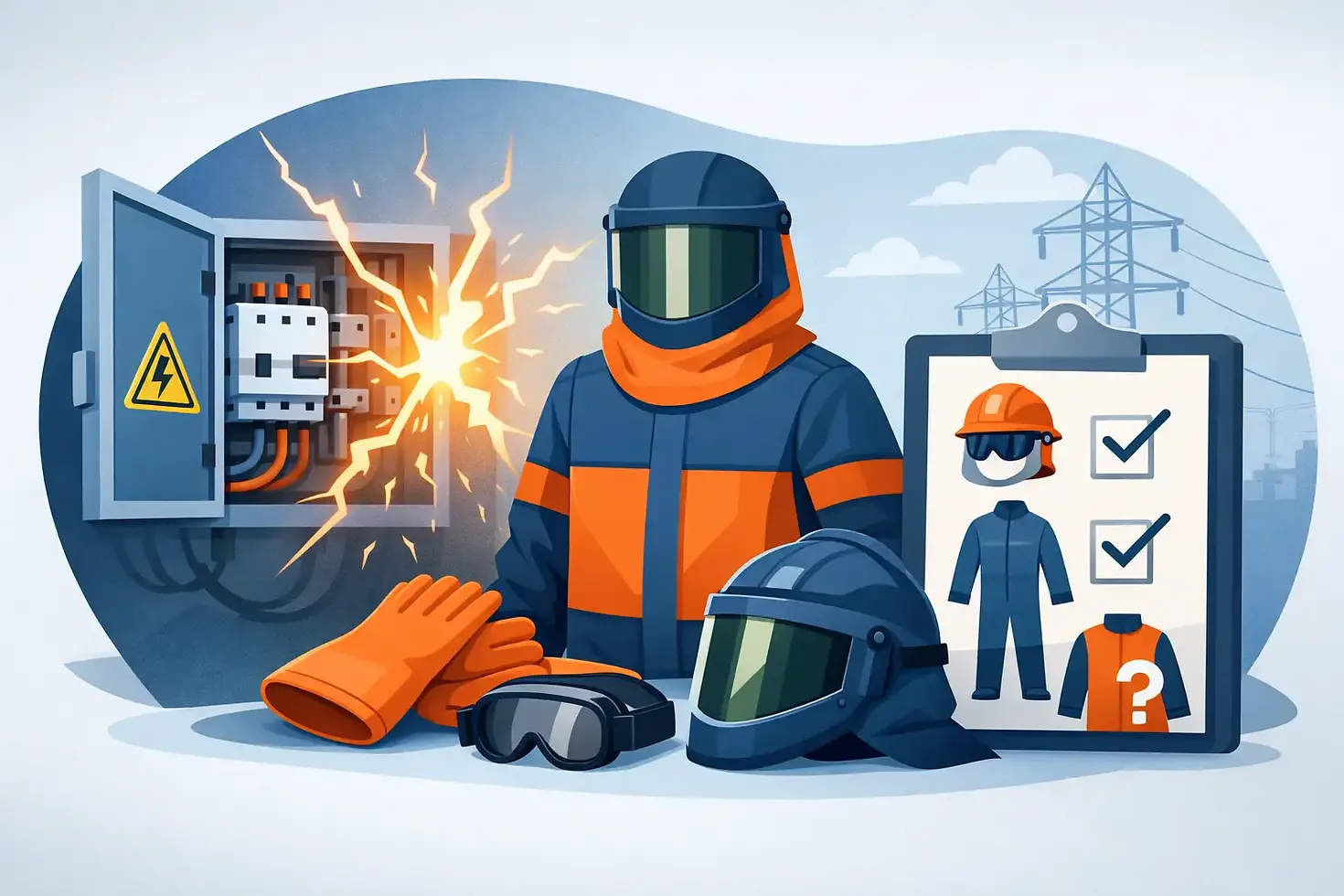
How to Choose Arc Flash PPE Correctly

A worker standing in front of 480V gear does not need a guess. They need the right protection for the actual hazard in front of them. That is why knowing how to choose arc flash PPE matters at the job planning stage, not after someone has already opened the enclosure.
Arc flash PPE selection is not about buying the heaviest suit on the shelf and assuming more is always better. It is about matching protective equipment to the available incident energy, the specific task, the equipment condition, and the requirements in NFPA 70E. If you overspecify, mobility, visibility, heat stress, and task execution can suffer. If you underspecify, the consequences can be severe.
How to choose arc flash PPE from the hazard, not the habit
The starting point is the hazard assessment. Arc flash PPE should be selected from documented electrical system data and task-based exposure, not from shop tradition or a generic company rule. In a compliant program, that usually means you are relying on an arc flash study, current equipment labels, and an energized electrical work evaluation when justified energized work is being performed.
If your labels show incident energy, that value drives PPE selection. If your program uses the PPE category method allowed by NFPA 70E for qualifying equipment and tasks, then the category shown in the standard helps define the minimum clothing and equipment level. The key point is simple: PPE is chosen to match the exposure level, not the title of the employee or the age of the facility.
This is also where many facilities make an avoidable mistake. They treat PPE as the main control. It is not. PPE is one part of the risk control hierarchy. If the task can be performed in an electrically safe work condition, that comes first. If equipment changes, maintenance improvements, or engineered mitigation can reduce incident energy, those steps matter because they reduce the burden on the worker before PPE is ever put on.
Start with the arc flash label and study
When an up-to-date arc flash study is available, the label is usually the fastest field reference. It may list incident energy at a specific working distance, the required arc rating, the arc flash boundary, nominal voltage, and shock approach information. For PPE selection, the arc rating is critical.
The arc rating of the clothing system must meet or exceed the incident energy exposure listed for that equipment and working distance. If a label shows 8 cal/cm2, the worker needs an arc-rated clothing system equal to or greater than that value. If the exposure is substantially higher, the selected suit, hood, gloves, and accessories must all be appropriate for that level.
That sounds straightforward, but field conditions complicate it. Labels are only useful if they are based on current system conditions. A study completed years ago may not reflect transformer changes, protective device setting adjustments, added motors, modified utility contribution, or undocumented distribution changes. When the data is stale, PPE decisions can be stale too.
Understand the difference between arc-rated and "flame resistant"
One of the most common buying errors is assuming any FR garment is enough for arc flash work. It is not. For electrical tasks with arc flash exposure, the clothing must be arc-rated for the hazard.
Flame resistant describes a material response to ignition. Arc-rated means the garment has been tested for arc exposure and assigned a performance value. That rating tells you whether the clothing system can provide protection at the expected incident energy level. Without that rating, you are missing the number that matters for task selection.
The same caution applies to layered systems. Layering can increase total arc protection, but only when the system is understood and documented correctly. You should not assume two garments automatically add up to a known protection level unless the manufacturer or testing data supports that conclusion.
PPE category method vs. incident energy method
NFPA 70E allows more than one path, and the right method depends on your equipment and the quality of your electrical system data.
The incident energy method is more precise because it is based on the results of an arc flash study. It is generally the better option when a facility has current system modeling and labels in place. It lets you select PPE to the actual calculated exposure and helps identify where engineering changes may reduce required protection levels.
The PPE category method can be useful when the task and equipment meet the conditions specified in NFPA 70E tables. This method is simpler in the field, but it has limits. It depends on specific equipment types, fault current ranges, and clearing times. If those parameters are not met, you cannot rely on the table.
For many facilities, the real issue is consistency. Mixing methods without clear program rules creates confusion. Your electrical safety program should define which method applies, where it applies, and how workers verify the required PPE before starting work.
What arc flash PPE typically includes
Choosing arc flash PPE is not just about the shirt or coverall. The full system matters because arc flash injuries often affect the face, head, hands, and upper body first.
At a minimum, selection may involve arc-rated shirts and pants or coveralls, arc-rated face shields or hoods, hard hat components, voltage-rated gloves with leather protectors when shock protection is required, hearing protection, safety glasses or goggles, and leather footwear. For higher incident energy tasks, a flash suit hood and multilayer clothing system may be necessary.
Compatibility matters as much as rating. A face shield that fogs, a hood that limits visibility, or gloves that prevent proper dexterity can create secondary risk during switching or testing. That does not mean reducing protection. It means selecting gear that workers can safely function in while performing the assigned task.
How to choose arc flash PPE for real working conditions
Paper compliance is not enough in front of energized gear. The selected PPE has to work in the actual environment.
Start with the task. Is the worker racking a breaker, removing a bolted cover for diagnostics, taking voltage readings, or performing infrared inspection with the enclosure closed? These are not equivalent exposures. The job step affects both the likelihood of an arc event and the practical PPE configuration.
Then look at duration and heat load. A worker in a high-calorie suit inside a hot mechanical room may face fatigue and heat stress that affect judgment and execution. In that case, the answer is not to compromise the rating. The better answer may be to change the work window, reduce task duration, improve ventilation, rotate personnel, or pursue engineered mitigation that lowers the incident energy at the source.
Fit is another operational issue that gets ignored. Oversized garments can snag. Poorly fitted hoods can shift during movement. Gloves that are too bulky for the instrument or hardware can lead to awkward hand placement. PPE has to be stocked in usable sizes and configured for the actual people doing the work.
Do not separate arc flash protection from shock protection
Arc flash PPE selection often gets discussed on its own, but electrical safety decisions cannot stop there. A worker may need arc-rated clothing and shock protection at the same time.
That means reviewing voltage exposure, approach boundaries, insulated tools, glove class, and task method alongside the arc flash hazard. An arc-rated suit does not replace voltage-rated gloves. A face shield does not replace safe work practices. The best PPE decision is always tied to the full task risk assessment.
This is where supervision and training matter. Workers need to understand what the label means, what their clothing system rating is, when rubber insulating gloves are required, and when the task should not proceed until an electrically safe work condition is established.
Procurement mistakes that create safety gaps
Many organizations do not struggle with knowing they need PPE. They struggle with buying and managing it correctly.
A common issue is purchasing by category name alone without confirming the actual arc rating of the complete garment or system. Another is issuing premium gear but not training workers on limitations, inspection, and care. Damaged face shields, contaminated fabrics, worn closures, or mixed components from different systems can erode protection.
There is also a program management issue. If one site has current labels and another is working from outdated assumptions, PPE selection becomes inconsistent across the organization. Standardizing specifications, storage, replacement criteria, and field verification helps close that gap. This is where a practical provider such as ZMAC Electrical Safety can add value by tying engineering data, field labeling, program documentation, and equipment selection into one process instead of treating them as separate purchases.
The right answer is often upstream
If your team keeps needing very high-level arc flash PPE for routine tasks, the question is not just what to buy next. The question is why the exposure remains that high.
Protective device coordination, maintenance condition, equipment design, remote operation options, arc flash relays, enclosed breaker solutions, and work practice changes can all affect the risk profile. PPE is necessary, but repeated dependence on the highest burden PPE can be a signal that engineered risk reduction has been deferred too long.
The best arc flash PPE decision is the one made with current study data, clear labels, trained workers, and a plan to reduce exposure over time. When you choose PPE from verified hazard information instead of habit, you protect the worker in front of the equipment and improve the safety program behind them.
The practical next step is to look at the label, verify the study behind it, and ask whether your PPE selection process is keeping pace with the system your people actually work on.


Comments