
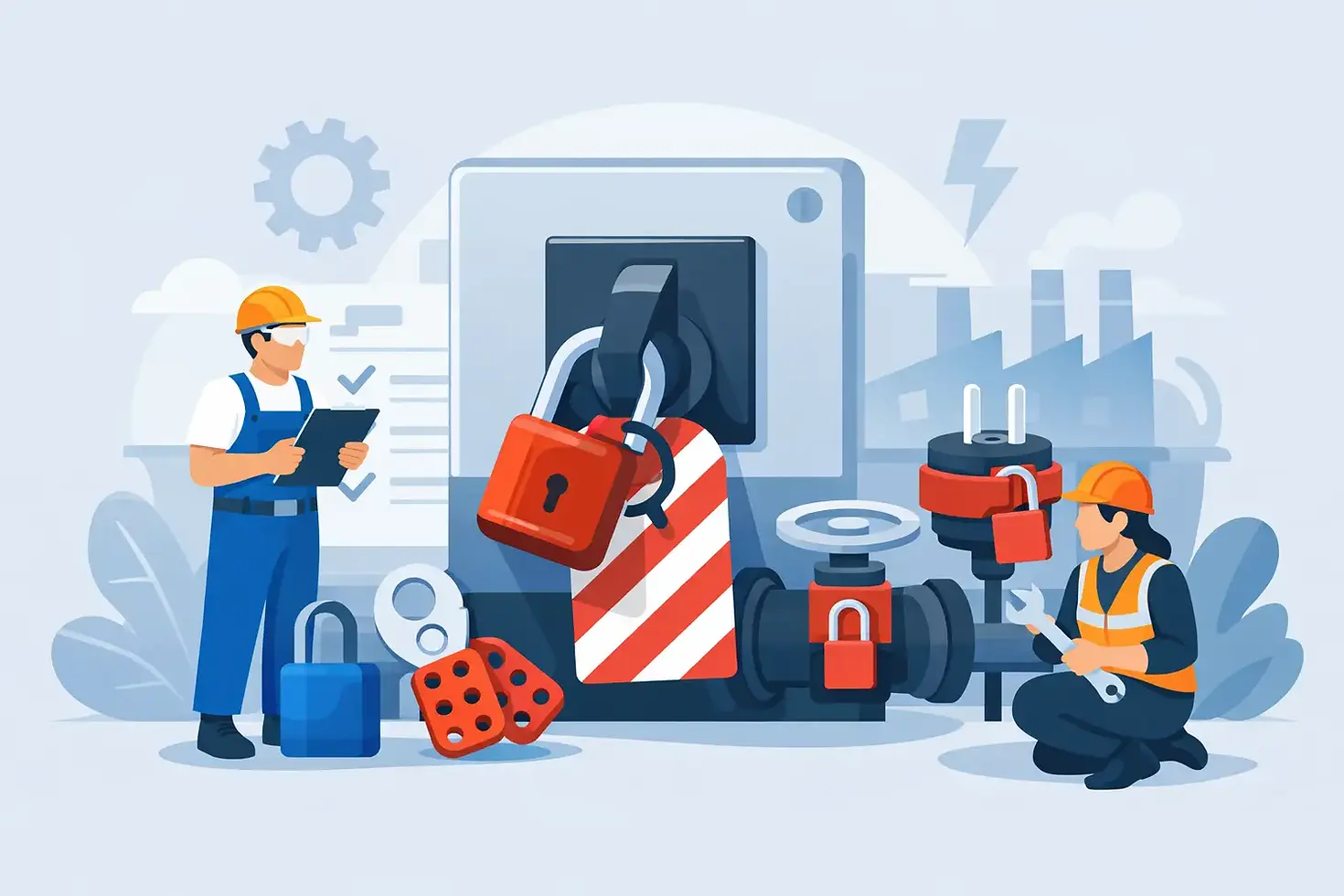
Best Practices for Lockout Tagout Implementation

A lockout point that is hard to identify at 2:00 a.m. during a breakdown is not a minor documentation issue. It is a direct exposure problem. The best practices for lockout tagout implementation are not about building a binder that looks complete. They are about making hazardous energy control clear, repeatable, and enforceable when maintenance is under pressure and equipment must be serviced safely.
In most facilities, lockout/tagout failure does not come from one dramatic mistake. It comes from small gaps that stack up - outdated equipment labels, undocumented secondary energy sources, missing device-specific procedures, inconsistent training, and supervisors informally approving workarounds to keep production moving. A workable program closes those gaps at the field level, not just on paper.
What effective lockout tagout implementation actually looks like
A compliant program is only the starting point. Effective lockout tagout implementation means authorized employees can identify every hazardous energy source, isolate it correctly, verify zero energy, and maintain control of the lockout until the task is complete. Affected employees understand what the lockout means, and management treats the procedure as a production requirement, not an administrative delay.
That sounds straightforward, but electrical systems rarely stay simple. Facilities expand, contractors modify equipment, temporary feeds get added, and one-line diagrams drift away from reality. Mechanical, pneumatic, hydraulic, thermal, and stored electrical energy can all be present in the same work zone. The best programs are built around field verification and disciplined updates because conditions change faster than most written procedures do.
Best practices for lockout tagout implementation start with a current energy map
If you cannot clearly define what must be isolated, the rest of the program will fail under real conditions. Start by identifying all hazardous energy sources for each machine, process, or electrical task. That includes normal electrical feeds, backup power, capacitors, stored mechanical motion, pressure, gravity, elevated parts, residual heat, and any interconnections that can re-energize equipment unexpectedly.
For electrical systems, current one-line diagrams matter. If a disconnect is mislabeled, if a panel schedule is inaccurate, or if field modifications were never incorporated into documentation, an authorized employee may lock out the wrong source while believing the equipment is safe. This is where electrical safety and lockout/tagout overlap directly. Energy isolation depends on accurate system knowledge.
A practical approach is to review documentation first, then validate it in the field with operations, maintenance, and qualified electrical personnel. On older sites, this often reveals control power feeds, tie breakers, or external equipment dependencies that were missed in earlier procedures. Those findings should not stay in markup form. They need to be integrated into updated procedures, diagrams, and equipment identification.
Standardize procedures, but do not oversimplify them
Many facilities swing too far in one of two directions. They either write a generic corporate procedure that does not reflect actual equipment, or they create highly detailed procedures that are so cumbersome no one uses them during real work. The right balance depends on equipment complexity, task frequency, and the consequences of a missed isolation step.
Machine-specific procedures should be written for the worker standing in front of the equipment. That means clear identification of energy sources, exact isolation points, the sequence of shutdown and isolation, methods for dissipating stored energy, and the required verification steps. Photos, device IDs, and consistent naming conventions help. So do procedure formats that match how technicians actually work in the field.
At the same time, not every task needs the same level of procedural detail. Simple equipment with a single, clearly identified energy source may be handled differently than switchgear lineups, large air handlers, or integrated production cells. Overengineering every procedure can slow adoption and create its own noncompliance problem. The standard should be precise enough to prevent error and practical enough to be followed every time.
Verification is the step that separates paperwork from control
Too many programs treat applying the lock as the critical endpoint. It is not. Verification is what confirms hazardous energy has actually been controlled. For electrical work, that means more than opening a disconnect and assuming the load is de-energized. Workers must verify isolation using the correct testing process and suitable equipment, following established electrical safety procedures.
This is also where training quality becomes visible. If personnel do not understand induced voltage, stored charge, alternate sources, or the difference between control-circuit interruption and full energy isolation, they can complete the lockout sequence and still remain exposed. Verification needs to be written into the procedure, taught in training, supervised in practice, and reinforced during audits.
For complex systems, group lockout methods and documented turnover controls are also essential. When multiple crafts or shifts are involved, the risk often comes from assumption: one team believes another verified the system, or a supervisor removes a device before all work is complete. Group lock boxes, sign-on controls, and clearly assigned primary authorized employees help keep accountability intact.
Training should be role-based and field-tested
Annual awareness training alone will not support a reliable program. Authorized employees, affected employees, and supervisors each need different training depth. Authorized employees need procedure-level competence. Affected employees need to recognize when lockout/tagout is in place and what restrictions apply. Supervisors need to know how to enforce the process, manage exceptions, and stop unsafe shortcuts before they become routine.
The most useful training is tied to actual site equipment and actual site procedures. Generic examples are fine for baseline concepts, but they do not prepare a technician for a mixed-voltage facility with aging distribution gear, multiple MCCs, and equipment that has been modified over twenty years. If the site has high-risk electrical exposure, training should align lockout/tagout with broader electrical safety practices, including shock and arc flash risk controls.
Competency checks matter here. Ask employees to walk through a lockout on real equipment. Review whether they can identify all energy sources, select the right devices, perform verification correctly, and explain the release-from-lockout process. If they cannot do that without coaching, the program is not ready.
Audits should find operational weakness, not just document completion
Periodic inspections are required, but many organizations treat them as a signature exercise. That misses the point. A strong audit process looks at whether procedures still match the equipment, whether authorized employees follow the written sequence, whether hardware is available and used correctly, and whether production pressure is driving unsafe deviations.
It is useful to inspect a range of conditions - planned maintenance, emergency repairs, contractor activity, and shift changes. These are the moments when the program is most likely to break down. If a procedure only works during daylight hours with the senior electrician present, it is not a strong procedure.
Audit findings should lead to corrective action with owners and due dates. If labels are wrong, fix them. If isolation points are inaccessible, address that condition. If a repeated task requires excessive workarounds, redesign the procedure or consider engineered changes to improve isolating means. In some cases, the right answer is not more training. It is better equipment configuration.
Hardware, labeling, and engineering support matter more than many programs admit
A lockout/tagout program cannot perform well if workers are improvising with mismatched devices, unreadable tags, or unclear disconnect identification. Standardized lockout hardware, durable labels, clearly marked isolation points, and accessible disconnects reduce error. They also reduce the time required to execute the procedure, which matters when maintenance teams are under operational pressure.
For electrical systems, there is a broader lesson. Administrative controls are necessary, but they are not always enough by themselves. If equipment design makes isolation difficult or exposure remains high, engineered improvements should be part of the conversation. That may include better disconnecting means, improved annunciation, enclosure upgrades, or other changes that reduce reliance on worker judgment alone. ZMAC Electrical Safety LLC often works in that overlap between documentation, training, and engineered mitigation because real risk reduction usually requires all three.
Make ownership clear across operations, maintenance, EHS, and contractors
Lockout/tagout programs often stall because everyone supports them in principle, but no one owns the details. Maintenance may write procedures, EHS may maintain the policy, operations may control shutdown timing, and contractors may bring their own methods. Unless those roles are coordinated, gaps appear quickly.
Clear governance helps. Someone should own procedure updates. Someone should control hardware standardization. Someone should verify that electrical documentation stays current after modifications. Contractor lockout expectations should be defined before work starts, not negotiated during the outage. The best practice is simple: assign responsibility where the work happens, then verify it consistently.
Facilities do not need a perfect program on day one. They need a program that reflects actual hazards, supports the people doing the work, and gets stronger every time the system changes. If your procedures cannot hold up during a rushed shutdown, a contractor outage, or a nighttime callout, that is where the next improvement should start.


Comments