
How to Reduce Arc Flash Risk at Your Facility
- Alfred Craig

- May 23
- 6 min read
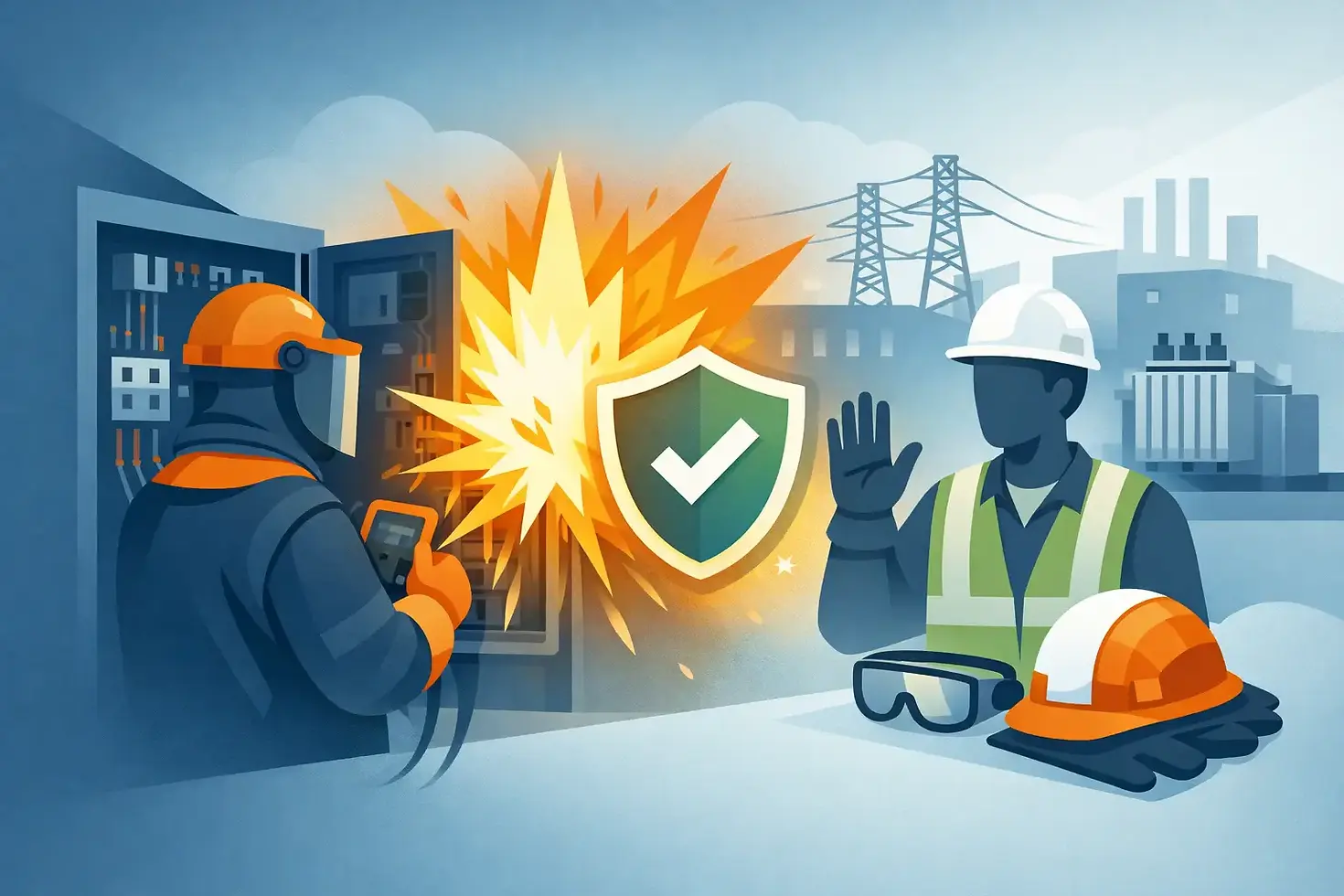
An arc flash incident rarely starts with one dramatic mistake. More often, it starts with familiar conditions that have been tolerated for too long - outdated one-lines, energized troubleshooting treated as routine, labels that no longer match the system, or equipment operating beyond its original design assumptions. If you are responsible for worker safety, uptime, or compliance, knowing how to reduce arc flash risk means addressing those conditions before they combine into an injury event.
The most effective approach is not a single product or a single study. Arc flash risk reduction comes from layered controls: accurate system data, engineering analysis, equipment changes, work practices, training, and documentation that can stand up to real field use. Facilities that make progress usually do so in phases, but they start with the same principle - reduce both the likelihood of an arcing event and the severity of worker exposure if one occurs.
How to reduce arc flash risk starts with system accuracy
You cannot manage exposure correctly if the electrical system record is incomplete or wrong. Many facilities are working from one-line diagrams that no longer reflect field conditions. Transformers have been replaced, protective device settings have changed, added loads have altered fault current, and temporary fixes have become permanent.
Before any meaningful mitigation decisions are made, the system model has to match reality. That means validating equipment names, bus ratings, conductor lengths where relevant, available fault current, protective device types, and current settings. If your arc flash study is based on old data, the incident energy values and PPE guidance may no longer be dependable.
This is where many organizations lose time and money. They move directly to labels or PPE purchases without confirming the underlying analysis. The result is a safety program that looks complete on paper but leaves workers exposed to bad assumptions.
Perform or update the arc flash study
An arc flash study is the technical foundation for reducing risk. It identifies available fault current, clearing times, and incident energy levels at equipment where employees may interact with energized components. It also reveals where protective coordination and equipment design are increasing exposure.
A current study helps answer practical questions that matter in the field. Which equipment presents the highest incident energy? Where do clearing times become excessive? Which protective devices can be adjusted without creating unacceptable coordination problems? Which tasks should be prohibited or redesigned?
The trade-off is that a study by itself does not reduce risk. It identifies the problem and points to options. Real risk reduction happens when the findings are turned into engineering changes, revised procedures, labels, and training.
Facilities should also treat the study as a living document. Changes in utility contribution, transformer size, motor loads, or protective settings can affect results. NFPA 70E alignment depends on keeping that information current, not treating it as a one-time project.
Prioritize engineering controls before relying on PPE
If you want to know how to reduce arc flash risk in a durable way, start by asking how to reduce incident energy at the source. PPE is necessary, but it is the last line between the worker and the hazard. It does not remove the hazard.
Engineering controls often provide the strongest long-term improvement. In some systems, adjusting protective device settings can significantly reduce clearing time and lower incident energy. In others, maintenance switches, zone-selective interlocking, differential protection, arc flash detection systems, current-limiting devices, or higher-speed relaying may be justified.
Equipment replacement can also matter. Older switchgear and distribution equipment may not support modern mitigation methods, and deteriorated condition increases the chance of an initiating event. In some cases, enclosed circuit breakers, remote operation capability, or compartmentalized designs provide a practical path to lower worker exposure.
Not every facility can fund major capital upgrades immediately. That is normal. The right approach is usually phased remediation based on highest risk locations, worker interaction frequency, and operational impact. A targeted mitigation plan is more effective than waiting for a perfect budget cycle.
Reduce the need for energized work
One of the most overlooked ways to reduce arc flash risk is to reduce how often employees are exposed in the first place. The safest energized task is the one that never has to happen.
This requires discipline in planning, shutdown coordination, and maintenance scheduling. Too many organizations accept energized diagnostics or minor adjustments as business as usual because production pressure is high. That decision can expose workers to severe hazards for the sake of short-term convenience.
NFPA 70E is clear on the expectation to establish an electrically safe work condition when feasible. For facility leadership, that means building outage planning into operations rather than treating de-energization as an exception. It also means requiring justification when energized work is proposed and ensuring that the reason is legitimate, documented, and reviewed.
Remote racking, remote switching, better access design, and improved test points can help when interaction is necessary. These measures do not eliminate the hazard, but they can move the worker farther from the arc source and reduce exposure during specific tasks.
Label equipment correctly and make the labels usable
Arc flash labels are not a paperwork exercise. They are field communication tools. When they are missing, illegible, inconsistent, or based on outdated analysis, workers are forced to make decisions with incomplete information.
Effective labels should match the current study and be installed on the right equipment in a format that crews can read quickly. The label needs to support the actual decision in front of the worker: whether the task can proceed, what the boundaries are, and what PPE or precautions apply.
There is also a practical limit to what labels can do. A label cannot replace job planning, shock risk assessment, or a qualified person's judgment. It is one control in a larger system. If workers are relying on the sticker alone, the program is too thin.
Train qualified persons on the real equipment they use
Training is often treated as an annual requirement to complete and document. That is not enough. Arc flash risk reduction depends on whether employees can apply the rules under pressure, on the equipment they actually maintain.
Qualified person training should cover hazard recognition, boundaries, PPE selection, normal versus abnormal equipment condition, energized work decision-making, and emergency response. It should also connect directly to the site's protective devices, labeling method, switching procedures, and lockout/tagout expectations.
The gap between classroom understanding and field execution is where incidents happen. Supervisors should verify that employees know how to interpret labels, read one-lines, identify when equipment condition changes the risk, and stop work when the task exceeds the planned controls.
Refresher training is especially important after system modifications, incident investigations, procedure changes, or evidence that employees are drifting from established practices.
Build procedures that crews will actually follow
A technically sound safety program fails when the procedures are too generic, too complicated, or disconnected from the work. Electrical safety documentation should be specific enough to guide action and simple enough to use in real operating conditions.
That includes energized work permit processes where required, task planning expectations, shock and arc flash risk assessment steps, lockout/tagout coordination, and switching procedures for critical equipment. The goal is consistency. When every supervisor handles exposure decisions differently, the organization is depending on individual habit instead of a controlled process.
It also helps to standardize documentation across sites. Multi-site organizations often have uneven practices, especially after acquisitions or staffing changes. A common electrical safety framework reduces that variability and makes auditing more meaningful.
Maintain equipment to prevent arcing faults and long clearing times
Poor equipment condition affects both the chance of an arc flash event and the resulting severity. Dust buildup, loose connections, insulation failure, moisture intrusion, damaged doors, missing covers, and neglected protective devices all increase risk.
Protective devices must also function as intended. If a breaker does not trip within its expected clearing time because of poor maintenance or hidden defects, the incident energy can be much higher than the study assumed. That is a critical disconnect.
Preventive and predictive maintenance should focus on the components that influence failure likelihood and protective performance. Infrared inspections, torque verification where appropriate, breaker testing, relay testing, and condition-based inspections all support arc flash risk reduction when they are tied back to the actual hazard profile of the system.
Treat arc flash risk reduction as an operating discipline
The facilities that improve fastest are not the ones with the thickest binders. They are the ones that treat electrical safety as an operating discipline with ownership, deadlines, and follow-through. That means assigning responsibility for study updates, label replacement, training intervals, one-line revisions, maintenance tasks, and remediation projects.
For many organizations, the best results come from combining engineering analysis, training, field labeling, and mitigation hardware into one coordinated effort. ZMAC Electrical Safety supports that model because it closes the gap between identifying hazards and fixing them.
If you are deciding where to start, begin with the areas where workers interact most often and where incident energy is likely to be highest. Progress does not have to happen all at once, but it does have to move from data to action. That is how arc flash risk comes down in the real world.


Comments